
History of Orange
The origins
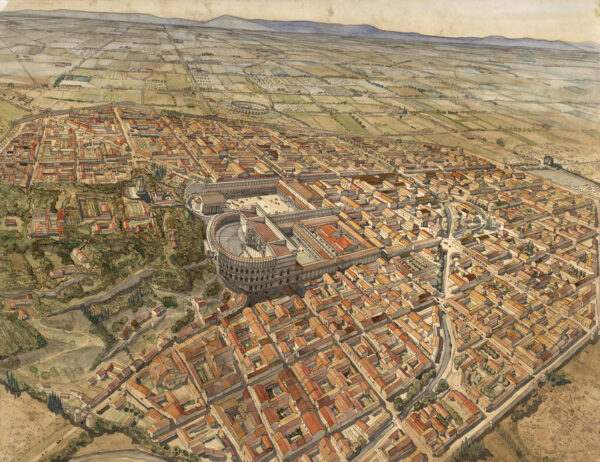
The town of Orange, formerly known as Arausio, probably owes its name to a deified river, the location of which is still debated today. In 36 BC, it became a Roman colony populated by veterans of the 2nd Gallica Legion, appointed on Julius Caesar’s initiative. The town then adopted a Roman grid layout. Orange flourished in antiquity, not least because it lies at the intersection of the Via Agrippaa Roman road designed by Marcus Vipsanius Agrippa in the Ier century BC, which linked Arles to Lyon and structured Gaul. Orange became an urban center, with a forum and a series of temples, including the one next to the theater, now a ruin. The city was adorned with remarkable monuments, such as the Theater and the Arch of Triumph, which served as the city’s gateway, symbolizing the peace regained under Augustus on the borders and within the Empire.
Middle Ages and modern times
In the Middle Ages, the town came under various authorities, becoming a principality in 1163. Orange is ideally situated at the crossroads between the Holy Roman Empire, the Kingdom of France and the County of Provence, and benefits from its proximity to the Papacy of Avignon. What’s more, it lies on a plain in the Rhône valley, synonymous with important trading and rural activities. In the 16th century, it became part of the House of Nassau, giving it political and military importance. Attached to the Kingdom of France in 1713 by the Treaty of Utrecht, Orange has preserved an important historical heritage, witness to its rich past, which you can enjoy at the Museum of Art and History, located opposite the Roman Theater in Orange.
History and origins of theater
Built at the beginning of the Roman Empire during the reign of Augustus (1st century AD), the Roman Theater in Orange is the best-preserved Roman theater in the Western world. In its heyday, the Theatre was Orange’s main cultural venue, hosting numerous plays and symbolizing Roman power in the region.
After its golden age in Antiquity, the Theatre was invaded by the Barbarians in the5th century , during which it was burnt down and plundered. It was gradually abandoned with the triumph of Christianity. In the Middle Ages, stones were removed from the terraces and reused in the surrounding area, while the Theatre was taken over by dwellings, saving its elevation. It also became a defensive post, and a sentry box was built around its perimeter. It wasn’t until the 19th century and the intervention of Prosper Mérimée (Inspector of Historic Monuments) and Auguste Caristie (architect) that it was restored to its original purpose. Classified as a UNESCO World Heritage Site in 1981, the Roman Theater in Orange remains today a cultural Mecca.
Architecture and features
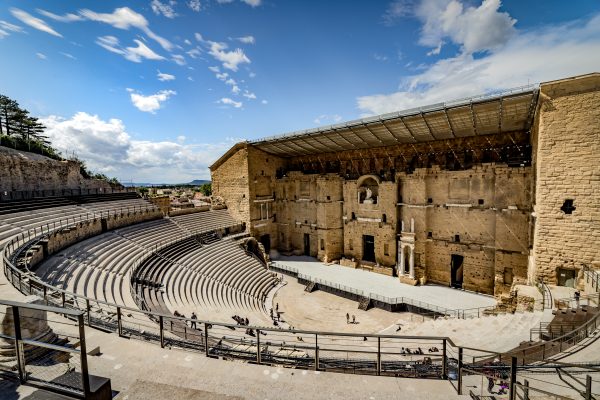
The Théâtre d’Orange follows the classical Roman model, inspired by the Théâtre de Marcellus in Rome. It is built into the northern slope of the Saint-Eutrope hill and comprises three main sections:
Bleachers: The term used by the Romans is cavea. It refers to the hemicyclic seating for up to 9,000 spectators. Social hierarchy was respected, with notables placed closest to the stage. Citizens were placed in the rows above them. Finally, slaves, foreigners and women were placed in the rows furthest from the stage.
The stage wall: 37 metres high, it provided excellent acoustics and served as a permanent backdrop. The arrangement of the tiers and the construction materials, such as the various sandstone limestones, ensure that the sound quality remains intact. It was richly decorated with columns and statues made of marble from Italy, Tunisia and Turkey.
The stage: From the Latin scaena, this 61-metre-long stage is flanked by backstage areas known as basilicae (the two towers on the east and west sides of the theater). Actors performed on the front part of the stage, the pulpitum. The unique stage curtain was lowered into a pit rather than raised. The stage floor is 1.20 m above the ground, a space that was used for machinery in Roman times.
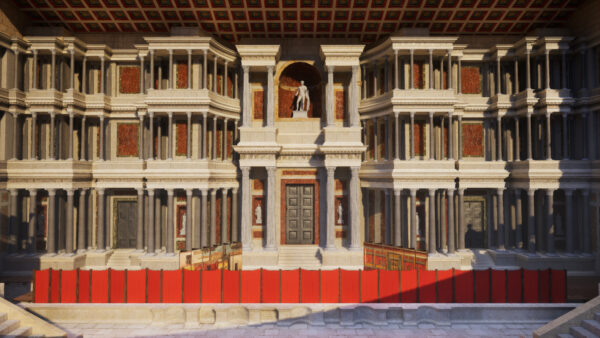
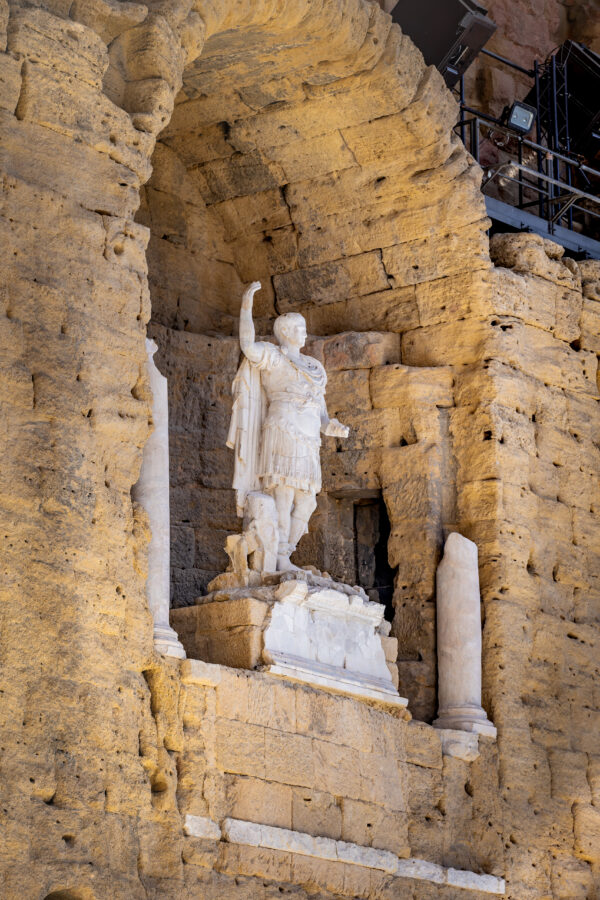
Another eye-catching feature nestling at the heart of the stage wall is the white marble statue of Augustus. Partially destroyed, the statue was reassembled in 1950, and several pieces of different statues were used in its restoration. The result is not quite historical. Initially, it was a statue of Augustus or even Apollo. As the heads were removable, the face changed with each successive emperor. The Gaul at the foot of the statue represents Roman rule in Gaul.
Shows in Antiquity
The Romans were fond of entertainment, and the Théâtre d’Orange hosted a wide range of shows:
Tragedies are performances accompanied by choruses. During the reign of Augustus, when the Roman Theater in Orange was being built, tragedies were often neglected or reserved for small theaters dedicated to quality texts, the odeons.
Comedies, on the other hand, were inspired by Greek authors such as Sophocles and Euripides, but adapted to Roman culture by authors such as Plautus and Terence. These were humorous plays inherited and adapted from the Greek model, in particular the works of authors such as Menander. These performances, often staged at religious festivals or public events, combined social satire, misunderstandings, disguises and misunderstandings of love.
Atellan farce is a burlesque comedy featuring caricatured characters wearing exaggerated masks. Of Oscan origin (an ancient people of present-day Italy), Atellan farce was the first form of short play improvised at the end of a tragedy. Popularized by the success of these shows, it led amateur actors to turn professional. Four typical characters – Maccius, the gluttonous peasant; Bucco, the starving man; Pappus, the miserly, thieving old man; and Dossenus, the hunchbacked vagabond – recur in every performance.
Mime and pantomime are two types of silent performance accompanied by music and dance. Pantomime is a Roman invention that emerged at the end of the Republic (509-27 BC). The actor, alone on stage, embodies several characters through codified gestures, accompanied by a chorus and orchestra. Mythological tales, often tragic, form the basis of the show. Mime, for its part, appeared at the beginning of the Empire and gradually replaced the atellan farces. More than a simple introduction, it became a show in its own right. Relatively short, the mime is inspired by legends mixed with romantic intrigues and amorous adventures, parodying domestic life as well as politics and mythology.
These shows were marked by special effects, such as stage machinery ( sparsiones projecting droplets onto the audience or activating a machine that pulled characters on stage) and the use of mobile sets such as periactes (pivoting triangular structures). These performances were free and sometimes compulsory, as the Roman powers used them to entertain and “control” the population.
Theater today
Since the 19th century, the Roman Theater in Orange has been restored to its original vocation, and every year hosts numerous performances that contribute to its enhancement, as well as being open to visitors 365 days a year.
Since 1869, the Chorégies d’Orange has been the world’s oldest opera festival, enjoying an international reputation thanks to both the theater’s exceptional acoustics and the renown of its guest artists. They are also renowned for their grandiose sets, such as those for Elektra (1991), Les Contes d’Hoffmann (2000) and Le Barbier de Séville (2018).
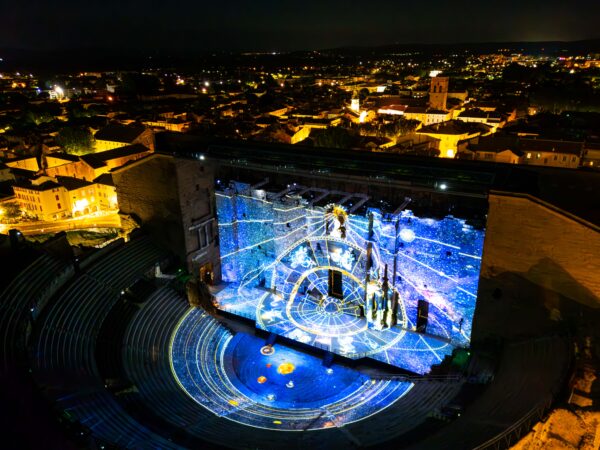
Every summer since 2019, the POSITIV Festival has taken over the Roman Theater in Orange to offer a series of unmissable musical events. Since its inception, the festival has welcomed the biggest names on the global electronic scene, such as David Guetta, Martin Garrix, Timmy Trumpet and Paul Kalkbrenner. But it has also opened its doors to pop-rock legends such as Sting, Toto, Deep Purple and Woodkid, offering an eclectic program for all ages. Perpetuating the innovative spirit of the Théâtre Antique, the POSITIV Festival transforms each concert into an immersive experience thanks to videomapping, a technology in which light and projected images follow the shapes of the ancient wall to create spectacular visual effects.
For more than 150 years, the Roman Theater in Orange has resounded to the sounds of the greatest artists: Sarah Bernhardt, Dalida, Johnny Hallyday, Francis Cabrel, The Cure, Sting, Jamiroquai, David Guetta and Will Smith: Sarah Bernhardt, Dalida, Johnny Hallyday, Francis Cabrel, The Cure, Sting, Jamiroquai, David Guetta and Will Smith.
A wide range of visitor experiences are also on offer, including themed tours to discover Roman engineering or events that have marked the monument’s history, immersive experiences using virtual reality technology, and live shows featuring historical figures inside the monument. Educational workshops open to all are also offered during the summer season.
L’Odyssée Sonore – Quand les Dieux s’en mêlent (Sound Odyssey – When the Gods get involved) is a show offered every year, starting in May, for an extraordinary adventure at dusk.
Roman Theater in Orange presents a new chapter in its Odyssée Sonore: Quand les Dieux s’en mêlent.
This show, combining monumental videomapping and a 360° sound experience, will plunge you into a spectacular journey alongside Terra, the goddess of the Earth, to restore harmony between men and gods. After 2000 years of sleep, Terra, the goddess of the Earth, awakens at the Roman Theater in Orange. Gods and humans have drifted apart, and Chaos threatens to re-emerge. To avert catastrophe, Terra must convince her children, the other gods, to restore harmony between earth and heaven. A unique immersive experience in which the spectator becomes an actor in this mythological quest.